

Juno is an 11-year-old yellow Lab, about 74 pounds, and her mornings have followed the same script for the last couple of years. She lies on the kitchen floor, lifts her head, and then just stays there for a minute, working up to it. Her back legs stiffened up somewhere around her ninth birthday, and getting up off the hardwood takes her longer than it used to. She hesitates at our three back-porch steps before she goes down, and she gives the car door a long, doubtful look before she jumps in for the ride to the vet.
That is the problem I took to Dr. Patel at our local clinic. She did not reach for a prescription pad. She said keep her lean and keep her moving, and that a joint supplement was reasonable to try. So I did what I always do, I read labels, compared milligrams of glucosamine, chondroitin, and MSM, and landed on Cosequin, the Nutramax chewable tablet, as Juno's first joint supplement. I gave it to her for about eight months, and I still keep a tub in the pantry as a fallback. This is what those months actually looked like, the good and the so-so.
The Quick Verdict
A well-known, easy-to-give joint supplement that supported Juno's comfort in small ways over weeks, not days. It did not fix her stiff mornings, and I never expected it to. It made them easier.
Amazon Check Today's Price →The first joint supplement I trusted, and the one I still keep around
Cosequin is the Nutramax tablet Juno took for eight months, and the tub I reach for when we need a simple fallback. If your vet has given the okay and your dog is stiff in the mornings, this is a gentle, well-known place to start.
Amazon Check Today's Price on Amazon →How I've Used It
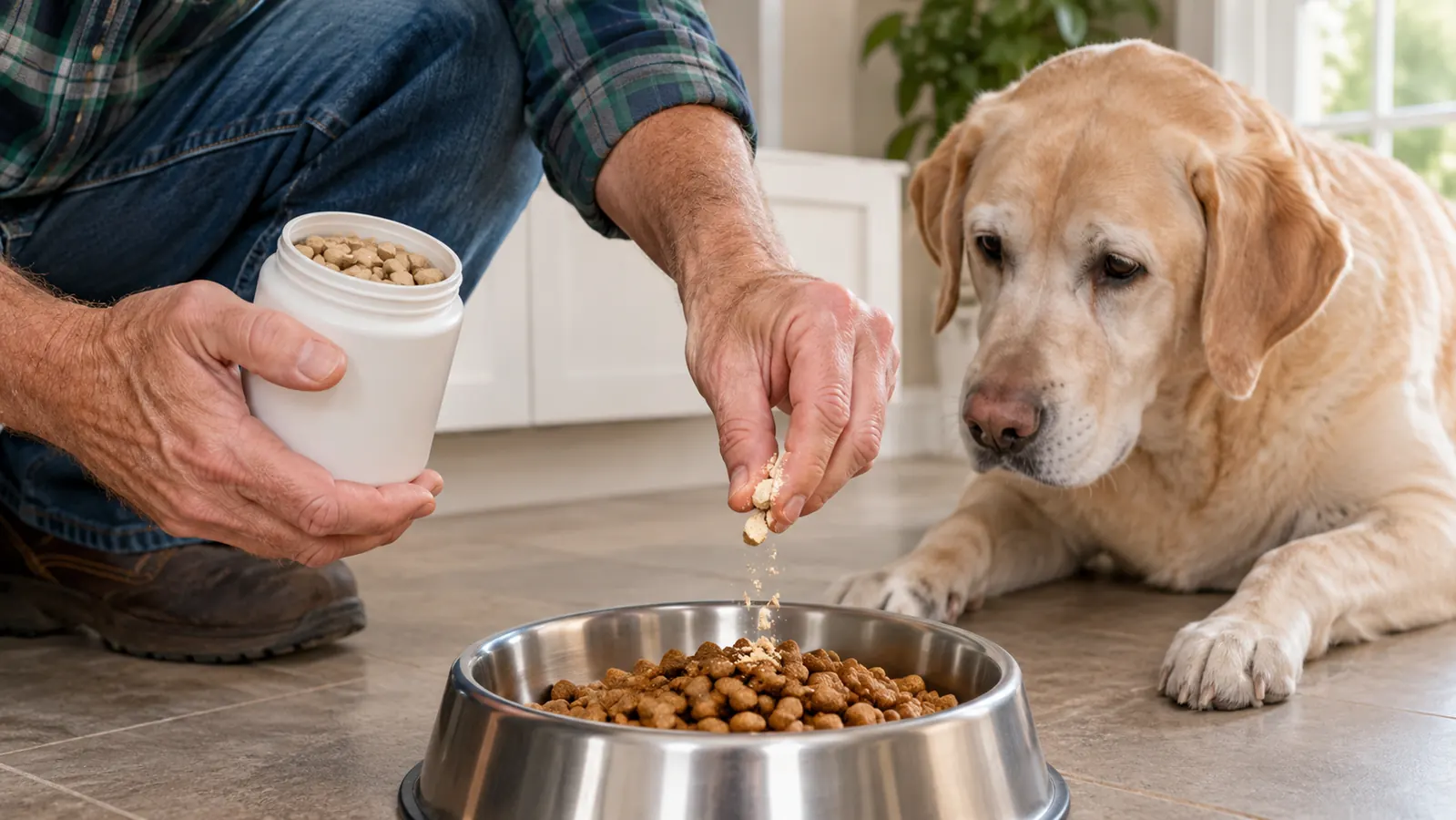
For those eight months, Juno got Cosequin every day, and I never had to fight her for it. Some mornings I crumbled it over her breakfast, and some mornings I just handed it to her like a treat and she took it straight from my fingers. The tablet is small, which helped. I do not tell anyone to guess at dosing. Follow the label for your dog's weight and check with your vet first. That is the whole rule, and I will say it again at the end.
I kept the rest of the routine steady, because a supplement is not a substitute for the basics. Juno still walked most mornings, up to about a mile and a half, slower in winter. She still ate a sensible amount, because Dr. Patel was clear that carrying extra weight is the hardest thing on an older dog's joints. The Cosequin went on top of all that, not instead of it. I think that is where a lot of people go wrong, they buy the chew and skip the walk.
I also gave her only the one joint chew at a time. For about a year now, she has had a daily pour of fish oil on her food as well, for her skin, her coat, and overall comfort, and that has stayed the same no matter which chew she is on. Two joint supplements at once never made sense to me, and I have never run them that way. The 132-count tub sat on the counter next to the fish oil bottle, and I never had to think about reordering. It lasted us the whole stretch and then some. I liked that it was not a subscription and not a bag of chews that went stale. It is a plain tub, the kind you can shove to the back of the pantry, and for a daily habit that is exactly what I want.
What's Actually in the Tablet
Cosequin is made by Nutramax, a company that has been in the pet health business for more than 25 years, and the listing calls it the number one vet-recommended retail joint health supplement brand. That reputation is part of why I started here instead of with something from a gas station shelf. When a brand has been around that long and vets keep recommending it, I figure the formula has survived some scrutiny.
The active ingredients are the ones I look for on every label now: glucosamine hydrochloride, sodium chondroitin sulfate, and MSM. Glucosamine and chondroitin are the building blocks a dog's body uses to maintain cartilage, the cushioning material inside the joints, and MSM is a sulfur compound that often shows up in joint formulas for comfort. The listing also names the specific forms, FCHG49 and TRH122, which tells me the company is being precise about what goes into each tablet.
I compared the milligrams on the label against the other chews I was considering, the way I compare nutrition facts at the grocery store. I am not going to recite numbers here, because the right amount depends on your dog's weight, and that is exactly what the label and your vet are for. What I will say is that Cosequin gives you the three ingredients I wanted to see, in a tablet that is easy to give, from a company with a long track record.
What Changed Over Eight Months
Here is the honest part. Nothing changed in the first week. I half expected that, but I still watched every morning, looking for Juno to pop up off the floor like she did at six. She did not. I mention this because a lot of supplement reviews skip it, and then people give up after ten days and decide the whole category is a waste.
Somewhere around week three or four, I started noticing that Juno was getting up off the kitchen floor on the first try more often. Not every time, but most mornings. The hesitation at the three back-porch steps got shorter too. She would stand at the top, think about it, and then go down, instead of standing there until I came over to walk her down. Those are small things, and they are the whole story. Nobody should buy this expecting a puppy again. I am not selling that, and Cosequin does not claim it either.
What it did was take the edge off the stiff mornings. Juno still has bad days, especially when winter settles in and the walks get shorter and the cold creeps into the house. She still gives the car a long look before she jumps in. Eight months of Cosequin did not make her nine again. It made her mornings a little easier, and for a 74-pound senior dog, easier mornings are worth something.
I also want to be fair about the winter. Juno's stiffness has always been worse in the cold months, and Cosequin did not change that pattern. It made the baseline better, so that when winter hit, she was starting from a better place than the year before. That is the most honest way I know to describe it.
Eight weeks in, Juno was getting up off the kitchen floor on the first try most mornings. It is a small win, and it was the whole win.
What I Liked
- The number one vet-recommended retail joint health supplement brand, per the listing, which is why I trusted it first
- Easy to give: crumbles over food or works as a plain treat, no fuss
- Glucosamine, chondroitin, and MSM in one tablet, the three ingredients I wanted to see
- 132-count tub lasts, and it stores fine in the pantry
- A gentle starting point before you spend on a pricier large-dog formula
Where It Falls Short
- Results took weeks, not days, and they were modest even then
- It did not help Juno's hesitation at the car, and I would not promise it will help yours
- The tablet needs breaking up for a dog who inhales food, or you are crumbling it anyway
- For a dog Juno's size, the large-dog formula was the better long-term fit, and that one costs more
Why I Still Keep a Tub in the Pantry
After about eight months, I switched Juno to Dasuquin, Nutramax's step-up formula for larger dogs, and it has been good for her. But I kept the Cosequin tub. Partly because it is a 132-count tub and there was plenty left, and partly because it is the easiest thing to reach for if we ever need a fallback.
The tablet form is the reason it is so easy. It crumbles over food without a fuss, and it works as a plain old treat on the days she is not hungry at breakfast. Some of the soft chews I tried later, she treated like cookies, which is charming until you are trying to ration them. Cosequin does not beg for itself. That is a feature at our house.
The tradeoff is honest. For a dog Juno's size, the vet and I both felt the large-dog formula was the better long-term fit, and that is the pricier option. Cosequin is the sensible starting point, the one I would try first, and the one I would keep around for a dog who is picky, or who only needs a little help with the stiff mornings.

Alternatives I Tried Along the Way
I have tried a few others since, always one at a time. Zesty Paws soft chews, which Juno loved like cookies, for about four months. VetriScience GlycoFlex 3, which I tried for about three months as a less expensive option. Both have their place, and I would not talk anyone out of them. The soft chews are easier if your dog refuses tablets, and the GlycoFlex formula has its own blend of glucosamine, MSM, and green-lipped mussel.
But Cosequin is the one I keep coming back to in my head when someone asks where to start. It is the brand with the vet-recommended reputation, the ingredients I recognize, and the tablet that goes down without a fight. If you want the full picture, the side-by-side comparison of Cosequin versus Dasuquin is worth a read, and so is the piece on why glucosamine tends to help senior Labs. The short version is that this is the low-stakes way to begin, and low-stakes is exactly what I wanted for Juno's first try.
The fish oil has been the constant through all of it, a daily pour on Juno's food for about a year now, alongside whichever chew she was on. It is not a joint chew, and I would not pretend it is. It is the everyday support for her skin, her coat, and her overall comfort, and it pairs fine with any of these.
What I'd Tell Anyone Starting Out
Ask your vet first. That is not a disclaimer I tack on to sound responsible, it is the actual first step. Dr. Patel knew Juno's history and her weight, and she gave us the green light before I bought anything. If your vet says a supplement is not needed, or recommends a specific one for a specific problem, that advice wins over anything you read here.
Give it six to eight weeks before you judge it. Joint changes happen slowly, and so does the relief. I almost wrote Cosequin off at week two, and I am glad I did not. Keep the rest of the routine honest too, the walks, the weight, the warm bed. A supplement works with those things, not instead of them.
Take a note of your dog's mornings before you start, and again six weeks in. I kept a mental list, up on the first try, hesitation at the steps, the car, and it kept me honest. Memory flatters, especially when you want something to work. A note does not lie.
And keep your expectations in the right place. I was not looking for a cure-all, and I did not get one. I was looking for easier mornings, and that is what showed up. If that sounds like too small a goal, this is probably not the product for you, and you can stop reading right here.
Who This Is For
Cosequin is for the person whose dog is stiff in the morning but otherwise happy, whose vet has said a supplement is reasonable, and who wants to start with the most well-known brand before spending on pricier formulas. It is for the picky eater who will not touch a soft chew, because the tablet crumbles into dinner without a scene. It is for the person who wants a supplement they will actually remember to give, because it is as easy as a treat.
If your dog is bigger, in the 60-pound-and-up range like Juno, you may eventually step up to the large-dog formula, and that is a reasonable move to talk over with your vet. Cosequin is still the right first conversation, because it is the low-stakes one. You are not locking into anything by trying it.
Who Should Skip It
Skip it if your dog is already on a joint supplement that is working, because there is no reason to stack them, and I would never run two joint chews at once. Skip it if your vet has recommended something specific for a diagnosed condition, because that advice wins. And skip it if you are hoping for a dog who runs like a puppy again. No supplement I have found does that, and I would not trust anyone who tells you otherwise. Cosequin supports comfort. It does not undo eleven years.
The tub I still keep in the pantry, for the mornings that need a little help
Cosequin was Juno's first joint supplement and it is still my fallback. If your vet has given the okay, this is a gentle, well-known place to start, and the 132-count tub will last you a good long while.
Amazon Check Today's Price on Amazon →