

If you have a senior dog, you have probably stood in the supplement aisle feeling torn. You want to help, you are not sure what actually works, and every label sounds like it was written by someone who has never watched a stiff old dog try to stand up. I am Corinne, and I have been there with my own dog. This is the honest version of what I learned after eight months of Cosequin, including the parts I would not have believed until I watched them myself.
Cosequin is the supplement most people try first, and for good reason. It is made by Nutramax, it has a strong reputation, and it is the brand my own vet mentioned before I ever bought a tub. But honest also means telling you what it is not: it is not a fix, it is not fast, and it is not right for every dog. Here is what I wish someone had told me before I started.
The Quick Verdict
A solid, well-made first joint supplement for dogs who are stiff but otherwise healthy. Expect modest, gradual changes over weeks, not a transformation, and always check with your vet first.
Amazon Check Today's Price →The supplement most vets recommend for a reason
If you are looking for a reputable place to start supporting your dog's joints, Cosequin is the one I keep coming back to. See today's price on Amazon.
Amazon Check Today's Price on Amazon →How I've Used It
My dog is an 11-year-old yellow Lab, about 74 pounds. She has always been a morning dog, but around the time she turned ten, that changed. She would lie on the kitchen floor and just look at me when I got up, like she was deciding whether the effort was worth it. The three back-porch steps got harder, and the car, a mid-size SUV, was out of the question without a boost. Before Cosequin, I had tried nothing. I had read articles, compared milligrams, and stood in the supplement aisle with my phone out, but I had not bought anything, because I could not decide. My vet, Dr. Patel, is the one who ended the dithering. She said keeping her lean and moving was the most important thing, and that a joint supplement was reasonable to try. That is when I bought Cosequin.
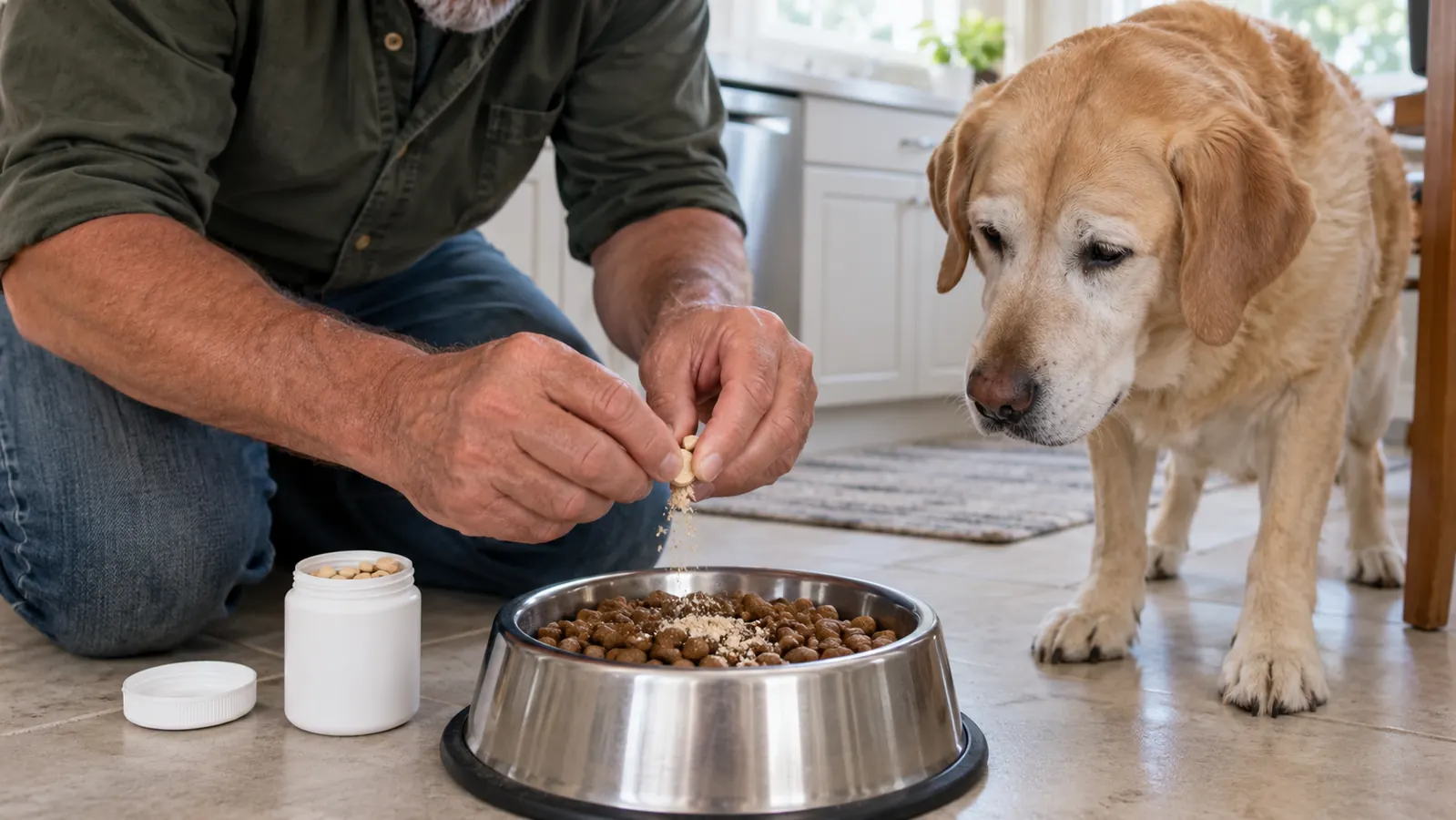
I started her on a Tuesday in early October, two years ago now. I remember because I wrote it on the kitchen calendar, the way you do when you are not sure something matters yet. The first attempt was her regular breakfast kibble with the tablet crumbled over the top. She sniffed it, ate the kibble around the crumbs, and left a neat little pile of tan dust in the bottom of the bowl. Dale said, well, that went well. The second attempt was a spoonful of plain yogurt with the crumbles stirred in. That worked for about a week, until she figured out the yogurt was a delivery system and started leaving the tablet behind.
What finally stuck was treating the tablet like a treat. I would sit on the floor with her, say the same word I use for cookies, and she would take it from my hand and crunch it. The crunch told me she was actually chewing it, which matters with a tablet this size. Some dogs will take it right out of your hand. Mine needed convincing, and the convincing took about two weeks.
The tub is the chewable tablet version, 132 count. I followed the label for Juno's weight and checked with Dr. Patel before I started, and a tub lasted me a good while. I bought a second one in January. I do not buy a second tub of something I think is a waste of money, and that is the quietest compliment I can give it.
I kept her on Cosequin for about eight months. I did not see a difference in the first week, and I almost stopped. The change came slowly, over weeks, and it was the kind of thing you notice in hindsight. One morning I realized she was getting up on the first try instead of the third. The hesitation at the porch steps did not disappear, but it got shorter. She still needed help into the car, but she stopped bracing herself the way she used to. Our walks stayed at about a mile and a half most mornings, a little shorter in winter, and the first sign I trusted came on the walk, not in the kitchen.
What Nobody Tells You About Cosequin
Here is the part I did not find on any label. Cosequin is a supplement, not a treatment. It supports joint health, which is different from fixing a joint. If your dog has a serious diagnosis, a mobility problem that is getting worse fast, or pain that seems to be more than stiffness, a supplement is not the answer. That is a conversation for your vet, and possibly for x-rays and prescription options. I am not a vet, and I will never pretend to be one.
The second thing nobody tells you is that the results are modest. The marketing makes it sound like your dog will run like a puppy. That is not what happened at my house. What happened was a slightly easier morning, a little less hesitation, a dog who seemed more comfortable on our walks. That is worth a lot to me, but it is not a cure, and I would be suspicious of anyone who promises you one.
Nobody tells you to keep a record, and I wish they had. For the first month I kept a little notebook on the kitchen counter. Every morning I wrote down one line: how many tries it took Juno to stand up, and whether she paused at the back door on the way out. October 12, two tries. October 19, one try, the first time in months. October 27, she trotted to the car instead of walking. None of those is dramatic on its own. But when I flipped back through the notebook in December, the pattern was right there. If I had trusted my memory instead of the notebook, I would have told you Cosequin did nothing.
Nobody tells you that consistency matters more than the brand. I missed a few days in November when we were traveling, and by the third missed day she was back to two tries in the morning. It came back after a few days back on the tablet, but the lesson stuck with me. This is a daily thing, or it is not much of a thing. If you are the kind of person who will forget on busy mornings, be honest with yourself before you buy.
Nobody tells you to have the conversation with your vet before you buy, not after. I called Dr. Patel's office before I ordered, and that one phone call saved me from guessing at the dose. She asked about Juno's weight, her activity level, and whether she had any health problems. When I answered, she said following the label for a dog her size would be reasonable. That is the kind of guidance no label can give you, and it is the reason I always say ask your vet first.
The third thing is the tablet itself. It is small, which is good, but it is not soft. If your dog is picky, or if you have a dog who swallows everything whole, you will need to crumble it or hide it in something sticky. I learned the hard way that a tablet left in a bowl gets found and ignored.
The change came slowly, over weeks, and it was the kind of thing you notice in hindsight. One morning I realized she was getting up on the first try instead of the third.
The Ingredients, Read Like a Label
The active ingredients in Cosequin are glucosamine hydrochloride, sodium chondroitin sulfate, and MSM. Glucosamine and chondroitin are the building blocks people usually think of for joint support, and MSM is included for additional support. I read labels the way some people read the news, and I will tell you plainly: the science on these ingredients is not settled, and different dogs respond differently. What I can tell you is that Cosequin uses these ingredients at meaningful levels, and it is made by Nutramax, a company with a long history in pet health.
One detail on the label that I liked: it names the specific forms, glucosamine hydrochloride and sodium chondroitin sulfate, with the code numbers FCHG49 and TRH122 attached. That is the kind of specificity I look for, because it means the company is telling you exactly what is in the tablet instead of hiding behind a blend. MSM was the ingredient I had to look up the first time. It is a sulfur compound that shows up in a lot of joint supplements, and it is there for additional support. I am not a chemist, and I am not going to pretend the research is unanimous. I am telling you what is on the label and why I found it reasonable.
The tub itself is nothing special, a standard cylinder that weighed about 12 ounces on my kitchen scale and fit fine in the cabinet next to the fish oil bottle. The tablets are small, round, and tan, with no strong smell, and the label notes the product is free of almond allergens, which I noticed because I check those things. The lack of smell is either a good thing or a problem depending on your dog. Mine needed the treat trick, and once she learned it, the routine took about thirty seconds.
Nutramax has been making pet supplements for over 25 years, and Cosequin is their most well-known joint product. That reputation matters to me, because I am giving it to my dog every day. I want a company that has been doing this for a long time, not a brand that appeared on the internet last month.
One thing I will say about the dosing: do not guess. Follow the label for your dog's weight, and check with your vet if you are unsure. More is not better, and your vet knows your dog's health history better than any label can.
I will also tell you what the label does not say. It does not promise to cure anything, and it does not use the word arthritis. The wording is careful: joint health support. That careful wording is part of why I trusted it, because a company that plans to be around for another 25 years does not overpromise.
What I Liked
I liked that Cosequin is easy to find, easy to store, and easy to give. The tub lasted a long time, the tablets did not go bad in my cabinet, and the small size made it simple to hide in food. I liked that my vet recognized the brand immediately and did not raise an eyebrow. That matters when you are the one standing in the kitchen at 7 a.m. wondering if you are doing the right thing.
I also liked the price. I am not going to quote a number, because prices change, but Cosequin sits at a reasonable spot for a daily supplement. It is not the cheapest option on the shelf, but it is not the most expensive either, and for a product from a company with this kind of track record, I thought it was fair.
I also liked that Cosequin gave me a way to do something. When your dog gets older, there is a helpless feeling that comes with watching her slow down. A daily tablet is not a big thing, but it is a concrete thing, and it made me feel like I was not just standing there watching.

What I Didn't Like
The tablet was the biggest annoyance. My dog is not a pill eater, and crumbling a tablet every morning gets old. I also wish the tub had clearer guidance about what to expect. I spent the first few weeks wondering if I was wasting my money, because nobody told me that joint supplements work slowly and quietly.
And on the days she was feeling picky, nothing worked. I tried peanut butter, I tried cream cheese, and both times she licked the spread off and left the tablet on the floor. Those mornings I crumbled it into her food and hoped, and some of those mornings she ate around it. It was not a disaster, but it was a reminder that a supplement only works if it gets eaten.
One morning in late November I came downstairs and she was slower than usual, the kind of morning where she needed both hands under her chest and a gentle lift to get going. It was cold, the hardwood was cold, and she had been lying in the same spot for a while. I remember thinking, this is the day the supplement shows it is worth it. It did not. She was stiff that day. The next morning she was better. That is the honest shape of it. Good days and bad days, and over time the good days started to outnumber the bad ones.
I also want to be honest about the limits. Cosequin did not fix the car problem, and it did not make the porch steps easy. She still needs a hand under her back end to get into the SUV, and the three steps still get a pause, but the pause got shorter, and some mornings she takes them without stopping at all. It made things better around the edges. If you are looking for a dramatic change, you will be disappointed, and I think it is fair to tell you that now.
What I Liked
- Made by Nutramax, a company with over 25 years in pet health
- Contains glucosamine, chondroitin, and MSM at meaningful levels
- Small, easy-to-hide tablets that store well
- A brand most vets recognize and consider reasonable to try
- A sensible starting point for a senior dog with normal stiffness
Where It Falls Short
- Results are modest and gradual, not dramatic
- Tablets are not soft and may need crumbling for picky dogs
- Not a treatment for serious joint conditions
- Needs a few weeks before you can judge whether it is working
- Not right for every dog; your vet should be the final judge
Who This Is For
Cosequin is for the owner of a dog who is getting older, a little stiff, a little slow, but otherwise healthy. It is for the dog who takes a moment to get up in the morning, who hesitates at the steps, who is not in crisis but is not what she used to be. If that sounds like your dog, Cosequin is a reasonable, low-risk place to start. It is also a good choice if you are new to joint supplements and want to begin with a brand that has a long track record.
Who Should Skip It
Skip it if your dog has a diagnosed joint condition, if she is in obvious pain, or if her mobility is declining quickly. In those cases, a supplement is not enough, and you need your vet's guidance first. Skip it if you are looking for a quick fix, because you will be disappointed. And skip it if your dog will not take tablets at all and you do not want to crumble them every day. There are other formats, like soft chews, that might be a better fit, and I have tried several of those too. And if you are the kind of person who will stop after two weeks because you cannot see a difference, be honest about that too. This supplement asks for patience, and it does not reward impatience. But for the right dog, Cosequin is a solid, honest choice.
Start with the brand your vet already knows
If you have talked to your vet and decided a joint supplement is worth trying, Cosequin is a sensible first step. Check today's price on Amazon and see if it fits your dog's routine.
Amazon Check Today's Price on Amazon →