

I'll say this up front: I wanted Dasuquin to work so badly that I almost convinced myself it was working before it actually was. My yellow Lab, Juno, is 11 and about 74 pounds, and for the last couple of years her mornings have been a slow production. She gets up off the kitchen floor in stages. She stands at the three back-porch steps and thinks about it. She hesitates before jumping into the car for vet trips. So when Dr. Patel said a joint supplement was reasonable to try, I did what I always do: I read labels, compared milligrams, and landed on Dasuquin for Large Dogs because it is the brand vets recommend most.
Six months in, here is the honest version. Some of it is good, some of it is fine, and some of it is stuff I wish someone had told me before I spent the money. That's what this review is for.
The Quick Verdict
A solid, vet-recommended daily joint chew that helped Juno's stiffness in small but real ways over about six weeks. It's not a fix for arthritis, it's not cheap, and it won't work if you expect it to do the work alone.
Amazon Check Today's Price →The brand your vet is most likely to name
Dasuquin is the #1 veterinarian recommended joint health supplement brand, and it's the one Dr. Patel was comfortable with for Juno. If you're ready to try it, check today's price on Amazon.
Amazon Check Today's Price on Amazon →How I've Used It
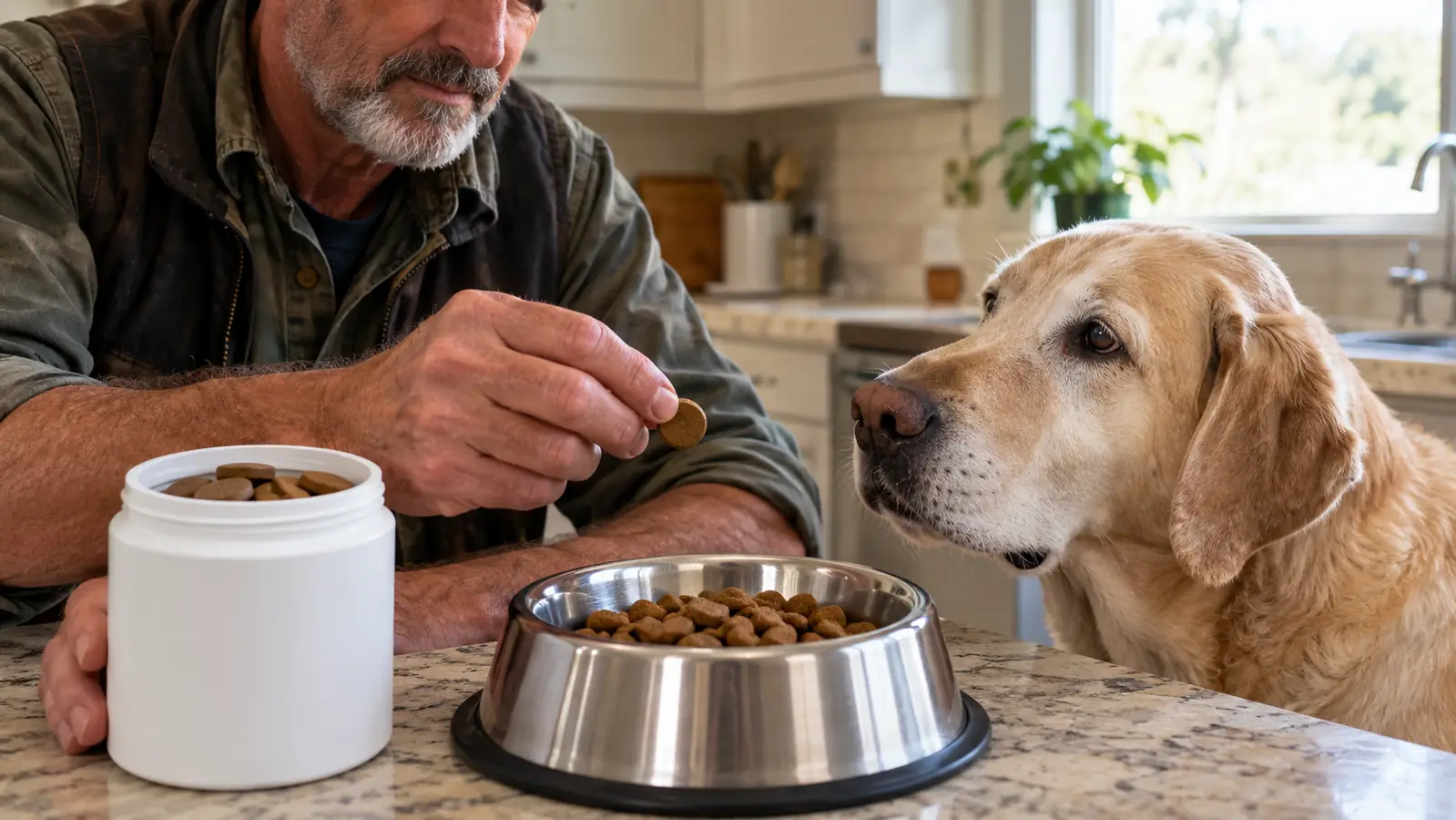
Juno has been on Dasuquin for Large Dogs for about six months now. She's 74 pounds, so she falls squarely in the large dog range, and I give it to her following the label directions for her weight, crumbled over her breakfast. The tablet is bigger than the Cosequin she used to take, and it has a smell she doesn't object to, which matters in this house. Most mornings I crumble it over her kibble in the same stainless bowl she's eaten from for years. She sniffs it once, eats around it for a second, then licks the bowl clean. If I'm slow getting it out of the cupboard, she stands by her bowl and looks at me, which is how I know she associates it with food rather than a fight. On the days I've had to give it to her at night instead, she takes it the same way, no fuss, which I mention because a supplement you have to wrestle into your dog is a supplement you'll eventually stop giving.
I want to be clear about the timeline, because it matters, and because the package directions don't tell you what to expect. The first two weeks I noticed nothing. Nothing at all. I kept a little mental checklist: does she get up faster? Does she take the three back-porch steps without pausing? Does she jump into the car instead of standing with her front paws on the seat, waiting for me to lift her rear? Around week four or five, I realized she was getting up from the kitchen floor in one motion more mornings than not. The morning I remember most clearly was a Tuesday in late October, the first really cold day of the season. She got up, walked to the back door, and took all three porch steps without stopping at the top to think about it. That had not happened on a cold morning in over a year. By week six, the hesitation at the steps was shorter more days than not. Not gone, but shorter. That's the honest pace of results with this product: weeks, not days, and never a straight line.
I also kept up the things that matter alongside any supplement, because Dr. Patel was clear that no chew does the work alone. Juno still walks most mornings, up to about a mile and a half, slower in winter when the cold makes everything harder. She stays lean because Dr. Patel said keeping her weight down matters more than any supplement. The Dasuquin is support, not a substitute for those habits, and I think that's exactly how it should be used. I also write down what I notice, nothing fancy, just a line in a notebook, and that's how I can tell you the good days started outnumbering the bad ones somewhere in the second month.
What Dasuquin Actually Is
Dasuquin for Large Dogs is a chewable tablet from Nutramax Laboratories Veterinary Sciences, the same company behind Cosequin. It's formulated for dogs 60 pounds and up, and it contains glucosamine, chondroitin, ASU (avocado soybean unsaponifiables) and more. The full ingredient story is on the label; what I can tell you from the package is that it's a joint health supplement designed to support healthy joints, not a drug and not a cure. The package is a 150-count pack of two, and the listing notes the information is per pack, so read it carefully before you assume anything about servings. The directions on the package are simple: follow them for your dog's weight, and check with your vet, which I did before we started.
The brand calls itself the #1 veterinarian recommended joint health supplement brand, and in my experience that checks out. Dr. Patel knew exactly what it was when I asked. My neighbor's vet recommended it for her shepherd. When I mentioned it to the tech at the clinic, she nodded like I'd said the obvious thing. There's real value in that familiarity: you're not experimenting with an unknown, you're trying the product your vet already trusts. That matters to me because I'm the person who reads every label and compares milligrams before I buy anything, and with a supplement the most important check isn't on the label at all. It's the conversation you have with your vet about whether your dog needs it in the first place. Dasuquin made that conversation easy, because it's a name they already know.
Where Dasuquin Genuinely Shines
First, the dosing is easy. No measuring, no syringe, no fight. Just follow the label for her weight, crumble it over her food, and done. Juno is not a dog who takes pills gracefully, and this is the first joint supplement we've used that she doesn't try to spit out. That alone has kept me consistent, and consistency is what makes a supplement have any chance of doing anything. I keep the package in the same cupboard as her food so I don't forget on busy mornings, and the routine has become as automatic as filling her water bowl.
Second, the formulation is the reason I switched from Cosequin. Dasuquin adds ASU, which is the part that made me choose it over going back to the tub I still keep as a fallback. I can't tell you from my own kitchen that ASU is the difference maker, because I'm one person with one dog. But I can tell you that when I asked Dr. Patel whether the step up was worth trying, she said it was reasonable, and that was enough for me.
Third, the results, such as they are, have held. Juno is not a spring chicken and never will be again. But six months in, her easier mornings are still there. She still has stiff days, especially when it's cold or after a hard walk, but the baseline is better than it was before we started. I noticed it most on the mornings after a hard walk the day before; those are the mornings that used to be the worst, and now she still gets up, just more slowly than on an easy day. That's what I'm paying for: a slightly better baseline, and nothing more dramatic than that.
The honest result after six months: Juno still has stiff days, but her easier mornings outnumber them now. That's the baseline I'm paying for.
What Nobody Tells You Before You Buy
Here's the part I wish someone had laid out for me before I ordered. First, Dasuquin is pricier than other joint chews, and the cost adds up because it's a daily product. It's not a one-time purchase. You will be buying this again, and again, and again, and if you're on a fixed income like I am, that's a real consideration, not a small one. I sat down with the math before we started, the way I do with everything, and I decided the cost was worth trying for six months to see if it did anything. What I'd tell you is to make that decision on purpose, with your eyes open, not to discover it three months in when the first pack runs low and you have to decide whether to reorder. And because it's a daily product, the cost is ongoing in a way that a one-time purchase isn't. We're not talking about a toy that lasts a year; we're talking about a chew that runs out and needs replacing on a regular schedule. I keep a reminder on the calendar to check the supply so I never run out, because missing days means starting the clock over.
Second, the tablet is bigger than you expect. It's a large dog chewable, and while Juno takes it crumbled over food without complaint, I can see why some owners struggle with it. The first time I tried to give it to her whole, she chewed it once, decided she wasn't interested, and left it on the kitchen floor. Crumpling it over her breakfast solved that, but it's worth knowing before you open the package. If your dog is picky about texture or smells, you may end up hiding it in peanut butter or cheese, which adds calories and defeats some of the purpose. Test one tablet before you commit to a 150-count pack of two. That's not a return-friendly purchase if your dog simply won't take it.
Third, and this is the big one: it will not fix the thing you're worried about. If your dog has a diagnosed joint condition, or is significantly stiff, or is in visible discomfort, a supplement is not the answer. Dasuquin supports healthy joints. It does not reverse damage, it does not treat arthritis, and no supplement should be your only plan. That's a conversation for your vet, and anyone who tells you otherwise is selling you something. I asked Dr. Patel directly what she expected from a supplement before I ever opened the package, and her answer was honest: it's reasonable to try, keep the weight off, keep her moving, and don't expect a cure. That is the correct expectation to bring to this product.
What I Liked
- Vet-recommended brand with a long track record
- Easy chewable that Juno takes without a fight
- Contains glucosamine, chondroitin, ASU and more for broad joint support
- Made by Nutramax, the same company as Cosequin
- Results showed up gradually and have held for six months
Where It Falls Short
- Pricier than other joint chews, and it's a daily cost that never ends
- Large tablet can be a challenge for picky dogs
- Results are modest and take weeks to appear
- Not a treatment for joint disease; it's support, not a fix
- 150-count pack of two is a big commitment if your dog won't take it

How It Compares to What We Tried Before
Dasuquin wasn't our first joint supplement, and I think that history is part of why I can be honest about it. About two years ago, Juno started on Cosequin from the same company, Nutramax, and we used it for roughly eight months. It was a small tan round tablet, easier to crumble than the Dasuquin, and I still keep a tub as a fallback because it worked fine for what it was. The tub still sits in the cupboard, and on the rare morning when I've run out of Dasuquin before a reorder arrives, I've crumbled that instead rather than skip a day entirely. Then we tried Zesty Paws Mussel Mobility Bites for about four months, a soft chew with a chicken flavor that Juno treated like cookies, which made it the easiest to give and the hardest to tell whether it was doing anything besides tasting good. After that came Dasuquin, with a three-month detour to VetriScience GlycoFlex 3, a cheaper option I hoped would match it, before going back. I gave Juno one joint chew at a time, never two at once. The one thing that ran alongside all of them was Nordic Naturals Omega-3 Pet, an unflavored liquid I've poured on her food every morning for about a year, for her skin and coat and overall comfort. It's not a joint chew, and I kept it going the whole time because it never seemed to conflict with anything.
What I learned from all of that is the part I'd want to hear if I were you. The soft chews were easier to give but didn't seem to do more for Juno's stiffness, and the cheaper option was cheaper for a reason I couldn't quite put my finger on. I couldn't tell you on any given day that one was clearly better than another. What I can tell you is that Dasuquin is the one where I noticed a real shift in her morning routine, and it's the one I've stuck with for six months, which is longer than I kept any of the others. That's not a lab result. It's one woman, one dog, one kitchen-table observation, and I'd never claim it as more than that. But it's an honest observation, and it's the reason I'd pay the difference again. One more honest note: I can't prove the Dasuquin caused the change. Juno could have had a good stretch on her own, or the cold weather could have been slower to arrive this year. I'm not a researcher and I don't pretend to be one. I'm a retired dental hygienist who reads labels, keeps a notebook, and notices when her dog gets up off the kitchen floor in one motion.
Who This Is For
Dasuquin is for the owner of a large dog, 60 pounds and up, who has talked to their vet and wants a daily joint support chew from a brand the vet is likely to recommend. It's for people who understand that supplements work slowly and modestly, and who can be consistent about giving it every day for months. If your dog is in the early or middle stages of stiffness, still getting around okay, and you want to support their joints alongside keeping them lean and moving, this is a reasonable thing to try. I'd also say it's for owners who can afford to keep it going. A supplement you have to stop after a month because of the budget won't get a fair chance to do anything.
Who Should Skip It
Skip it if your dog has a diagnosed joint condition or is in real discomfort; that's a vet's job, not a supplement's. Skip it if you're looking for a quick change, because you'll be disappointed for the first month. Skip it if you're not sure your dog will take a larger chewable tablet, because a 150-count pack of two is a lot of tablets to hide in peanut butter. And honestly, skip it if the cost is a stretch. There are cheaper options, and something you can afford to give every day beats something expensive you skip half the time.
Six months in, I'd buy it again
Dasuquin didn't fix everything, and I wouldn't expect it to. But it gave Juno a better baseline, it's easy to give, and it's the brand my vet knows. If that sounds like what you're looking for, check today's price on Amazon.
Amazon Check Today's Price on Amazon →Before you order, do what I did: ask your vet first. Bring the label, ask whether a joint supplement is reasonable for your dog, and ask what else you should be doing. For us, the answer was Dasuquin, plus keeping Juno lean and walking her most mornings. Your dog's answer may be different, and that's okay. That's what the vet is for.