
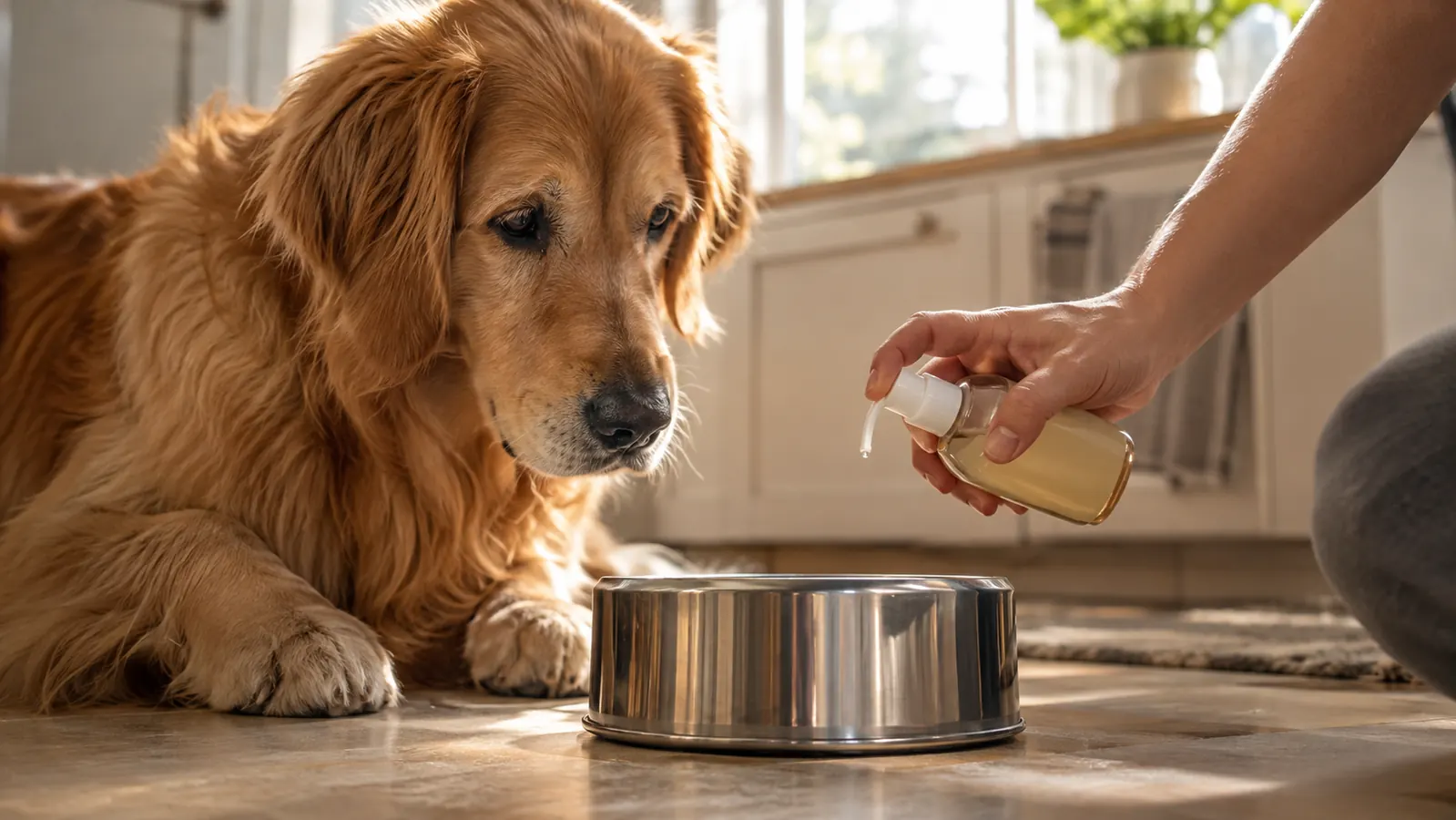
If your dog is anything like mine, breakfast stopped being simple a while ago. Juno is an 11-year-old yellow Lab, about 74 pounds, and she has always been the first one in the kitchen when the cabinet opens. Lately she is also the one who stands at the back door a little too long, and who needs a minute to get up off the hardwood floor in the morning. My vet, Dr. Patel, said the best things we can do for a stiff senior dog are keep her lean and keep her moving, and that a joint supplement was reasonable to try. So for about a year now, alongside her joint chew, I have been adding Nordic Naturals Omega-3 Pet to her breakfast every single morning.
This is the part I had to figure out by trial and error: not whether to give her fish oil, but how to actually get it into her meals without a mess, without a fuss, and without missing days. A liquid supplement is a little different from a chewable tablet. You have to store it right, measure it right, and get it onto food at the right time. After a year of pouring it on her kibble, I can walk you through the whole routine in five steps.
Start With a Fish Oil Made for Dogs, Not a Human Bottle
Nordic Naturals Omega-3 Pet is the unflavored liquid I keep on the counter for Juno. It is formulated for pets, with EPA and DHA in the triglyceride form, and the pump bottle makes the morning pour genuinely easy.
Amazon Check Today's Price on Amazon →Step 1: Start With Your Vet and the Label
Before I bought any supplement, I asked Dr. Patel. That is the step I would never skip, and I say it to every friend who asks about fish oil for their dog. Your vet knows your dog's weight, health history, and what else they are already taking. I remember the appointment clearly. Juno was due for her yearly checkup, and I brought the bottle with me in my purse so Dr. Patel could look at the label herself. She read the back, nodded, and said the omega-3s were fine to add as long as we kept the dose reasonable for Juno's weight. She also reminded me, the way she always does, that no supplement replaces keeping her lean and moving. That conversation settled the whole question for me, and I have not second-guessed the routine since. The label on Nordic Naturals Omega-3 Pet gives dosing by weight, and the bottle clearly lists it as a pet product with omega-3 fish oil in liquid form. Follow the label for your dog's weight, and check with your vet. That is the whole rule.
One thing that made this easier: we already had a routine. Juno was already on a joint chew, and the fish oil was never a replacement for it. Nordic Naturals Omega-3 Pet is not a joint chew, and I never treated it like one. It is the omega-3 support that goes alongside whatever chew she is on. For us, that meant no big change to breakfast, just one more small step.
I also checked the bottle's included components when it arrived, because I am a label reader. The product is straightforward: Nordic Naturals Pet Omega-3, 8 ounces, unflavored liquid. No artificial colors, flavors, or preservatives, and it is non-GMO, gluten-free, and dairy-free. That mattered to me, and it is printed right on the label.
Step 2: Store the Bottle Where You Will Actually Use It
Fish oil goes rancid if you leave it in a warm, sunny spot, and a rancid oil is worse than no oil at all. I keep the bottle in the refrigerator between uses, and I take it out when I make Juno's breakfast. It takes about ten seconds. The bottle is 6 by 2 by 2 inches, so it tucks into the fridge door without taking over a shelf.
Cold oil is also thicker, which means it pours slower and stays where you put it. That is a small thing, but it is the difference between a neat pour over the kibble and a puddle spreading across the bowl. The pump top helps too. You get a measured pour instead of a glug, and you can see exactly how much is coming out.
I learned this the hard way in the first week. I left the bottle on the counter by the stove, and by day four the oil had a noticeably stronger smell, the kind of fishy note that makes you wonder if it has turned. I did not want to risk giving her oil that had gone off, so I started over with a fresh bottle and kept that one in the fridge from day one. Now, at the end of a month, the bottle still smells clean and mild when I open the door. Storage is half the job, and it costs about ten seconds a day. I also write the date I opened the bottle on the label with a marker, so I know how long it has been in use and when it is time to replace it.
Step 3: Measure the Right Amount for Your Dog's Weight
This is the step where most people guess, and you do not have to. The label on the bottle gives the amount for your dog's weight, and that is the number I use. I never measure by eye. I use the pump on the bottle, and I follow the label's amount for her weight, once I had confirmed it with Dr. Patel.
The first morning I did it wrong. I poured a little extra because I felt sorry for her, watching her rock back and forth before she stood up. She was fine that day, but I read the label again that night and realized I had not been following it. The label gives the amount for your dog's weight, and that is the number I use now. Juno is 74 pounds, near the top of the medium range, so she gets the amount for her weight, not a splash for a smaller dog and not an extra pour on a stiff morning. More is not better with fish oil. Too much can upset a dog's stomach, and the whole point is to make breakfast easier on her, not harder. I keep a little note taped inside the cabinet door above her bowls with her weight and the amount from the label, so I do not have to remember it on a tired morning.
If you are between sizes on the label, or if your dog is on other supplements, that is exactly the question to take to your vet. Dr. Patel and I settled Juno's amount once, and I have not fiddled with it since. Consistency beats perfection.
Step 4: Pour It Over the Food, Not Around It
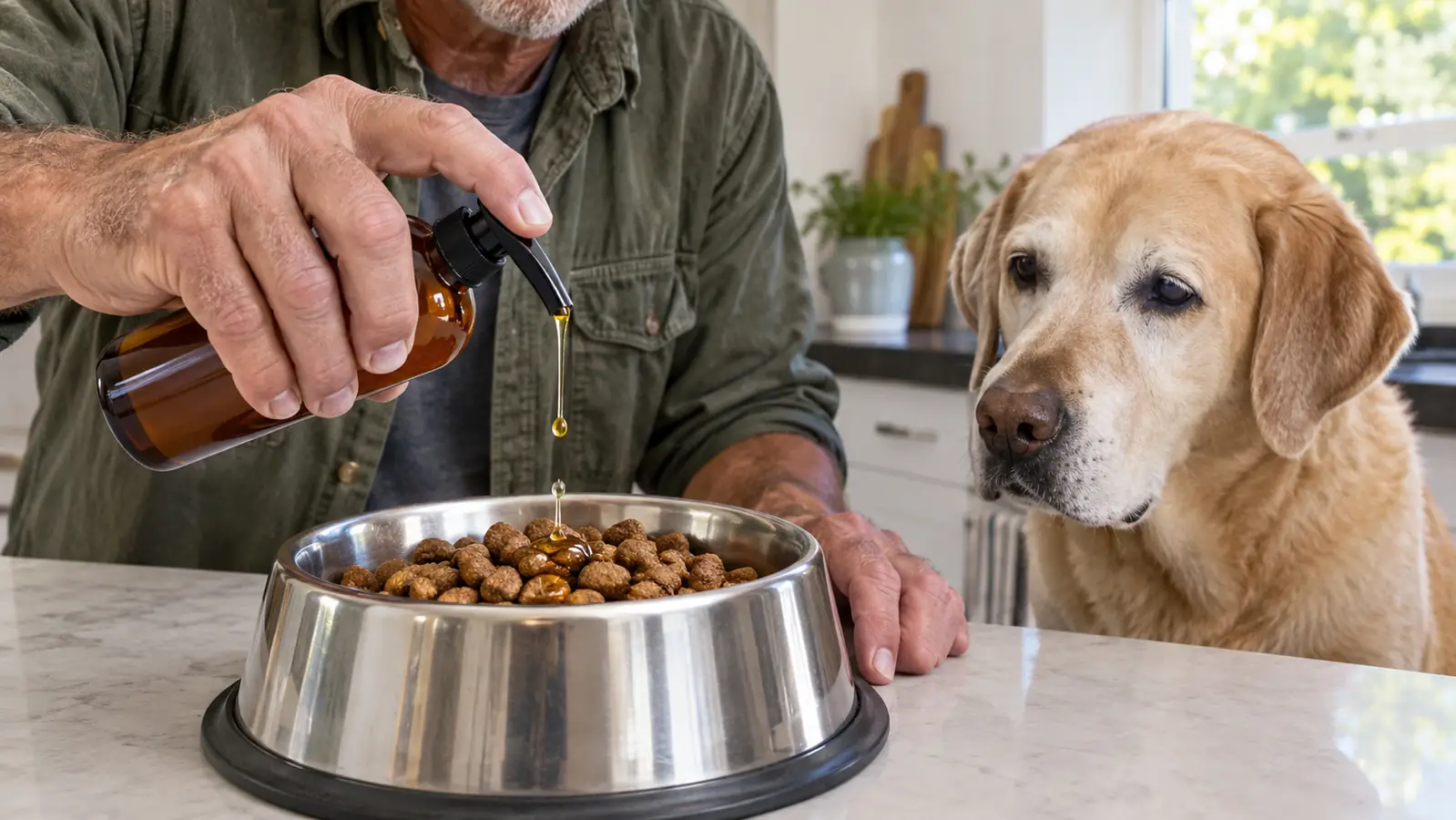
I pour the oil directly over Juno's kibble and give it a quick stir with her spoon. The oil coats the pieces instead of pooling at the bottom of the bowl. That way she gets the whole amount, not just the last few bites, and the bowl is easier to wash.
Timing matters more than I expected. I pour it right before I set the bowl down, not the night before. The oil stays fresh, the kibble does not get soggy, and Juno eats it while it is at its best. She has never turned up her nose at it. The unflavored liquid disappears into the food, and she eats breakfast the same way she always has.
If your dog is a slow eater or tends to leave some kibble in the bowl, stir the oil in well and watch the first few meals. You want the oil on the pieces they actually eat. For a dog who cleans the bowl, which is Juno's approach to every meal, a quick stir is enough.
Step 5: Keep a Simple Daily Rhythm and Watch for Small Changes
We do fish oil at breakfast, every day, and the bottle lives in the fridge so the routine is automatic. I pour her food, add her joint chew, add the oil, stir, and set the bowl down. It takes less than a minute, and because it is attached to a meal she never misses, I never miss a dose.
Give it weeks, not days. I did not see anything change in the first week, and I almost stopped pouring it. What I noticed, over about a month, was that Juno seemed more comfortable getting up from the floor in the morning. She still hesitated at the back-porch steps, but the hesitation was shorter, and she jumped into the car with a little less planning. I remember one Tuesday in particular, she got up from her rug, walked straight to the back door, and stood there waiting, no rocking back and forth at all. It was a small thing, but I noticed it, and it is the kind of moment you miss if you are watching for something dramatic. I keep my expectations modest, because no supplement is a fix for age. It is support, and that is how I describe it to anyone who asks.
If your dog has a sensitive stomach, or if fish has ever disagreed with them, start slowly and keep an eye on things. The label notes that this product contains fish, which is worth knowing if your dog has food allergies. And if a meal gets skipped, do not double up the next day. Just pour the normal amount at the next meal and carry on.
What Else Helps
Fish oil was one piece of Juno's routine, not the whole answer. The bigger pieces are the ones Dr. Patel keeps repeating: keep her lean, keep her moving, and do not let her jump off the porch or the car. Juno walks with me most mornings, up to about a mile and a half, slower in winter when the cold makes her back legs stiffer. One morning a few months in, on our usual loop past the old water tower, I noticed she was leading me instead of lagging a half step behind the way she had in the spring. That is the kind of small change I trust, the kind you only catch if you walk the same route often enough to notice. Those walks do as much for her stiffness as anything in a bottle, and they cost nothing. We also keep her at a healthy weight. Juno is about 74 pounds and the vet is happy with that, because every extra pound is extra weight for those back legs to carry.
I also pair the fish oil with a joint chew, one at a time. Right now she is on Dasuquin for Large Dogs, which we switched to about six months ago with Dr. Patel's okay, and the Nordic Naturals goes on top of her breakfast alongside it. The fish oil supports her skin, coat, eyes, heart, and overall comfort, while the chew supports her joints. They do different jobs, and I never try to run two joint chews at once.
The other thing that helped was making small changes around the house. We put a rug on the slickest part of the hardwood floor so she has a patch she can grip when she gets up. I added a little ramp of old bricks at the back-porch steps, which she uses about half the time. None of this is dramatic, but it all adds up to a dog who gets through the day a little more easily.
Give it weeks, not days. What I noticed, over about a month, was that Juno seemed more comfortable getting up from the floor in the morning. That is the honest version of what fish oil did for her.
The Morning Routine That Finally Stuck
A year in, this is the routine I still use every day: joint chew, a measured pour of Nordic Naturals Omega-3 Pet over the kibble, a quick stir, and breakfast on the floor. If you are looking for a simple way to add omega-3s to a senior dog's meals, this is the bottle I would buy again.
Amazon Check Today's Price on Amazon →