

If your older dog has started to slow down, you know the exact moments I mean. The pause at the bottom of the back porch steps. The extra beat before she gets up off the kitchen floor in the morning. The way she stands at the open car door and thinks about it instead of hopping in. She still greets me at the door and follows me from room to room, but the stiff part of her morning has gotten harder to ignore. That was my dog Juno last fall, an 11-year-old yellow Labrador Retriever, about 74 pounds, with back legs that did not want to cooperate first thing in the day.
I am not a vet, and I do not play one on the internet. I am a retired dental hygienist in Midland, Michigan, and for the last two years I have been the person who reads the fine print on dog supplement labels. Juno has had joint supplements on and off for about two years, and the one that fit her best was Zesty Paws Mussel Mobility Bites, a soft chew made with cold processed New Zealand green-lipped mussel and natural glucosamine. I compare milligrams of glucosamine, chondroitin, MSM, and omega-3 the way other people compare prices at the grocery store, and what I am is a woman who spent about four months giving these chews to her dog and keeping notes on what I saw. This is how I worked them into her routine, step by step, and what I would tell a neighbor doing the same thing.
A joint chew your dog will actually eat
Zesty Paws Mussel Mobility Bites are soft chews made with cold processed New Zealand green-lipped mussel, natural glucosamine and chondroitin, plus omega-3 fatty acids. They come in a chicken flavor that Juno treated like cookies. Follow the label for your dog's weight, and check with your vet before you start.
Amazon Check Today's Price on Amazon →Step 1: Ask your vet before you add anything
Before I ordered anything, I called Dr. Patel at our local clinic. That is the rule I follow with every supplement, and it is the first thing I tell anyone who asks what I give Juno. Dr. Patel knows her history, her weight, and her habits. A supplement that helps one dog can be wrong for another, and no label can tell you that. Your dog's age, weight, and health history all matter, and your vet is the one person who can look at all of it at once. That call took five minutes, and it saved me from guessing.
Dr. Patel's advice was simple: keep Juno lean and keep her moving, and a joint supplement was reasonable to try. Notice what that does not say. It does not say a chew will fix her. It does not promise she will run like a puppy. It says supporting her joints is worth trying while we do the boring work of keeping her weight down and her walks regular. I appreciated that honesty, because it matched what I was seeing at home.
If you are reading this because your dog hesitates at the steps, start here. Write down your dog's age, weight, and what you are seeing, and take that list to your own vet. You want a professional who has met your dog, not a stranger on a product page, deciding what goes in her bowl. Bring the jar or a photo of the label with you if you can, so your vet can see exactly what is in it. And if your vet says a supplement is not needed, trust that answer. The label on any jar is a starting point, not a prescription.
Step 2: Read the label and find the active ingredients
When I compare joint supplements, I look for the same things on every label: glucosamine, chondroitin, MSM, and omega-3 fatty acids. Those are the ingredients I can compare between products, and they are the ones I recognize after two years of reading labels for one dog. I also look at the form, because a soft chew is easier for an older dog than a hard tablet. The Zesty Paws label leads with cold processed New Zealand green-lipped mussel, and it also lists natural glucosamine and chondroitin plus omega-3 fatty acids. That combination is why I picked it up in the first place.
The other thing I noticed is that these are limited ingredient chews, which matters to me because Juno has a sensitive stomach and I have learned to be careful about extras. The label also lists chamomile among the active ingredients. I am not going to tell you what chamomile does for a dog, because I am not a vet and I do not guess about things like that. I will tell you that the list is short, and I like a short list. Fewer extras means fewer things that might not agree with her. That matters more to me than any single ingredient.
One honest note: the label does not list a separate number for every ingredient the way some other products do, so if you are the kind of person who compares exact milligrams like I do, you will have to be satisfied with the ingredients themselves. I was. The green-lipped mussel, the glucosamine, the chondroitin, and the omega-3s were the ones I wanted, and they are all right there on the label. For me, that was enough.
Step 3: Start with one change at a time
My rule for Juno has always been one joint chew at a time. I do not stack two chews together and hope for the best, because if something upsets her stomach, I want to know exactly which thing did it. When I switched to Zesty Paws, I stopped the chew she had been on and gave the new one a few weeks on its own. The fish oil stayed, because that is a separate part of her routine, but the joint chew was the only new thing in her bowl. I kept the bag in the same cabinet as her food so I would not forget.
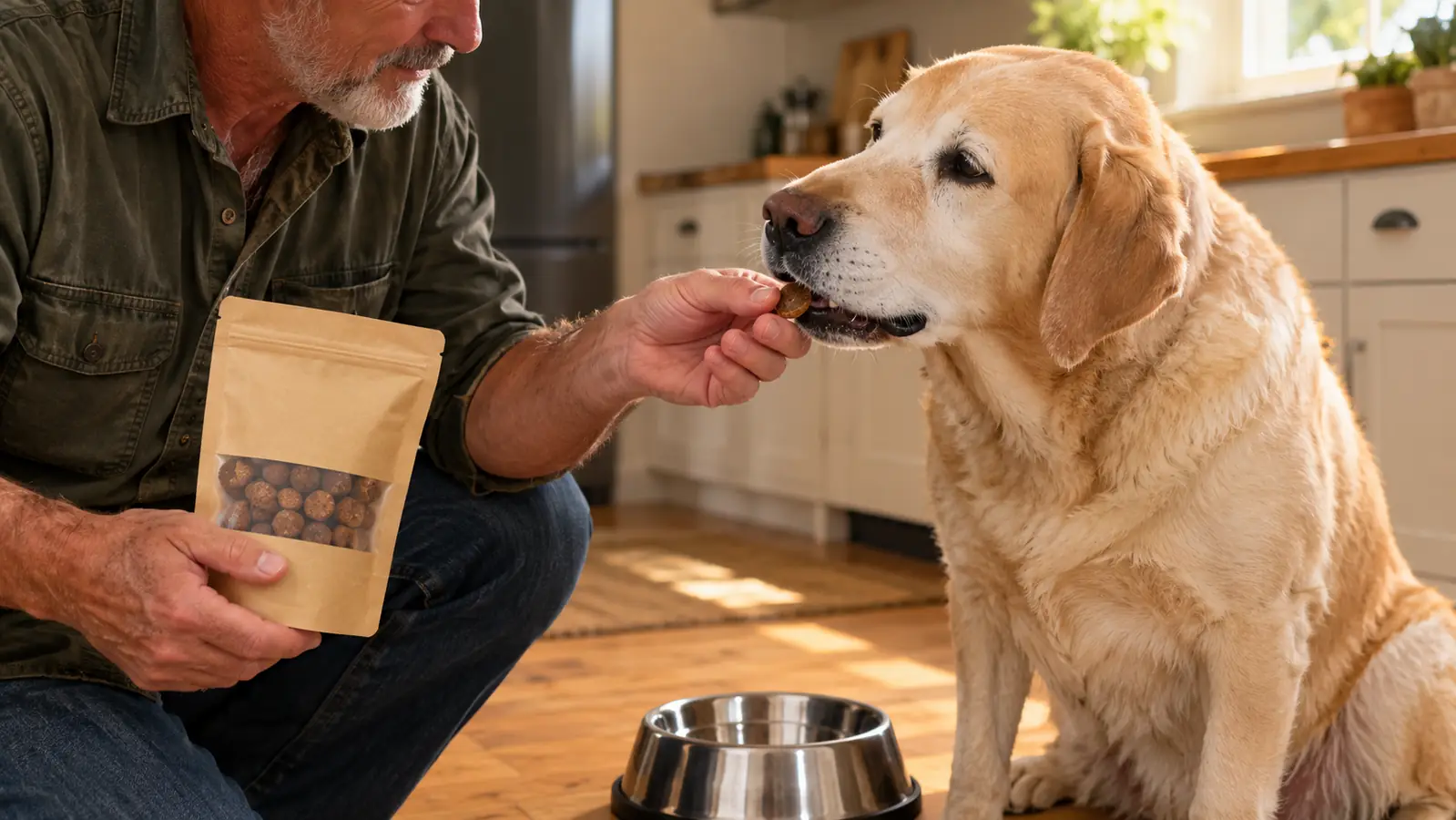
The first thing I noticed was that Juno treated these chews like cookies. They are soft chews in a chicken flavor, and she took them right out of my hand, no crumbling over food, no coaxing. That sounds like a small thing, but with a dog who has turned her nose up at supplements before, it is the difference between a routine that sticks and one that ends up in the back of the cupboard. A supplement only works if your dog will actually eat it.
I followed the label for her weight and gave it to her at the same time every day. I do not want to tell you how many chews to give your dog, because that number depends on your dog's weight and your vet's advice. What I can tell you is that the routine worked because it was boring and repeatable. Same time, same place, same soft chew, every single day. Dogs do well with routines, and older dogs especially do.

Step 4: Keep a little log of what you notice
I keep a note in my phone, nothing fancy. Date, whether Juno hesitated at the back porch steps, how she got up off the kitchen floor, how she loaded into the SUV for her vet trips. I started it because I know myself, and I know I will convince myself a supplement is working if I do not write down what I actually saw. A log keeps me honest, and it also gives me something concrete to share with Dr. Patel.
It took about three weeks before I noticed Juno getting up off the kitchen floor without the little grunt she used to make. That was the first real change, and it was small. By the second month, she was hopping into the car with less of a run-up, and she stopped standing at the bottom of the porch steps like she was doing arithmetic. I wrote all of it down, the good days and the not so good days.
I want to be honest with you: nothing about this was fast, and nothing was dramatic. If a product promises your old dog will move like a puppy in a few days, I would be suspicious. What I saw was gradual, over weeks, and it showed up in the small moments, the ones you notice only because you are watching for them. That is why I write them down. The log is the only reason I trust my own memory on any of this. It is easy to remember the good days and forget the hard ones.
Step 5: Pair the chew with the rest of the routine
A joint chew is one small part of keeping an older dog moving, and I think it works better when the rest of the routine is doing its job. Juno walks most mornings, up to about a mile and a half, and slower in winter. I keep her weight where Dr. Patel wants it, because every extra pound is weight on those back legs. The chew supports her joints, but the walks and the lean weight do the heavy lifting.
I have also made small changes around the house. We have hardwood floors, and I put down rugs on the paths Juno uses most, so she does not have to brace on slick boards. I do not rush her at the three back porch steps, and I let her take her time getting into the car. Winter is the hard season: her walks get shorter and slower when the cold sets in, and I have learned to expect that instead of pushing her. None of that is medical advice. It is just common sense for a dog whose legs are not what they used to be.
Think of the supplement as the easy part. The hard part is the boring routine around it, and the boring routine is what actually moves the needle. If you are not ready to do the walks and the weight management and the rugs, no soft chew in the world is going to make up for it. The chew and the routine work together, and I would not want one without the other. That has been the biggest lesson of the last two years.
What Else Helps
For the past year or so, Juno has also had a measured pour of unflavored liquid fish oil on her breakfast every morning. It is not a joint chew, and I do not pretend it does the same job. It supports her skin, her coat, and her overall comfort, and it has been part of her routine alongside whichever joint chew she is on. If you already give your dog a supplement, ask your vet whether fish oil is a sensible addition. I pour it on after her food is in the bowl, and she never seems to notice it is there.
Beyond that, the list is short: keep the weight down, keep the walks gentle and regular, fix the slippery spots in the house, and ask your vet before you add anything new. I know that is not a glamorous answer, but it is the honest one. The chews helped Juno's mornings get easier. Everything else is what made the chews worth giving in the first place.
I also learned to watch the little things. A dog who is stiff in the morning will often do better if you let her wake up slowly before the first trip outside, so I give Juno a few minutes to stretch before I open the back door. It is not a supplement, but it costs nothing and it seems to help.
It took about three weeks before I noticed Juno getting up off the kitchen floor without the little grunt she used to make.
Give your older dog the same soft chew that earned a spot in Juno's routine
Zesty Paws Mussel Mobility Bites are soft chews with cold processed New Zealand green-lipped mussel, natural glucosamine and chondroitin, and omega-3 fatty acids. They are chicken flavored, soft enough that Juno treated them like cookies, and easy to work into a daily routine. Follow the label for your dog's weight and check with your vet before you start.
Amazon Check Today's Price on Amazon →