

Juno is an 11-year-old yellow Lab, about 74 pounds, and for the last two years I have watched her mornings get harder. She was never a fast riser, but now it is a production. She sleeps on the kitchen floor because the hardwood is cool, and every morning she rocks forward once, sometimes twice, before her back legs get underneath her. The three steps off the back porch make her stop and think, and I have learned to wait instead of hurrying her. The car is worse. I keep a step stool in the back of the SUV, and I still end up lifting her rear end more often than I like.
Her vet, Dr. Patel, has been clear with me for a while now: keep her lean, keep her moving, and a joint supplement is reasonable to try. So I have tried a few. Last year I switched Juno from a pricier tablet, for about three months, to VetriScience GlycoFlex Extra Strength Healthy Hip and Joint soft chews, mostly because the cost was easier to live with. This is what those months looked like, what changed, and what did not.
The Quick Verdict
The most noticeable soft chew I have tried for Juno's stiff back legs, but it took about three weeks to show, and it did not fix everything.
Amazon Check Today's Price →See Today's Price for VetriScience GlycoFlex on Amazon
Sixty soft chews, chicken flavor, with glucosamine, MSM, and green-lipped mussel. It took about three weeks before I noticed Juno moving easier, and this is the chew I would buy again.
Amazon Check Today's Price on Amazon →How I've Used It
Juno gets her joint chew by the label for her weight, always with fish oil poured over her breakfast. I followed the label for her weight, and I checked with Dr. Patel before we started, which is the same thing I would tell you to do. One chew at a time, one tub at a time, no mixing two joint supplements just to see what sticks.
The chews are soft and chicken-flavored, and Juno treats them like a cookie. That matters at our house because she will not take a pill unless I crumble it into her food and hide it. With these, I just hand one over after breakfast and she chews it right there on the kitchen floor. The tub holds 60 chews, so one tub lasted us about two months, and I kept the tub on the top shelf because she would happily eat the whole thing if I left it out.
I kept everything else the same on purpose. Same morning walks, same food, same fish oil. If her mornings were going to change, I wanted to be able to point at one thing and say that was probably it. That is the only way a three-month test like this means anything.
I will also say this: I did not start Juno on GlycoFlex cold. She had been on other joint supplements before, so her system was used to the idea. If your dog has never had a joint chew, I would start slowly and watch for any stomach upset, the way you would with any new food. We had no trouble, but every dog is different.
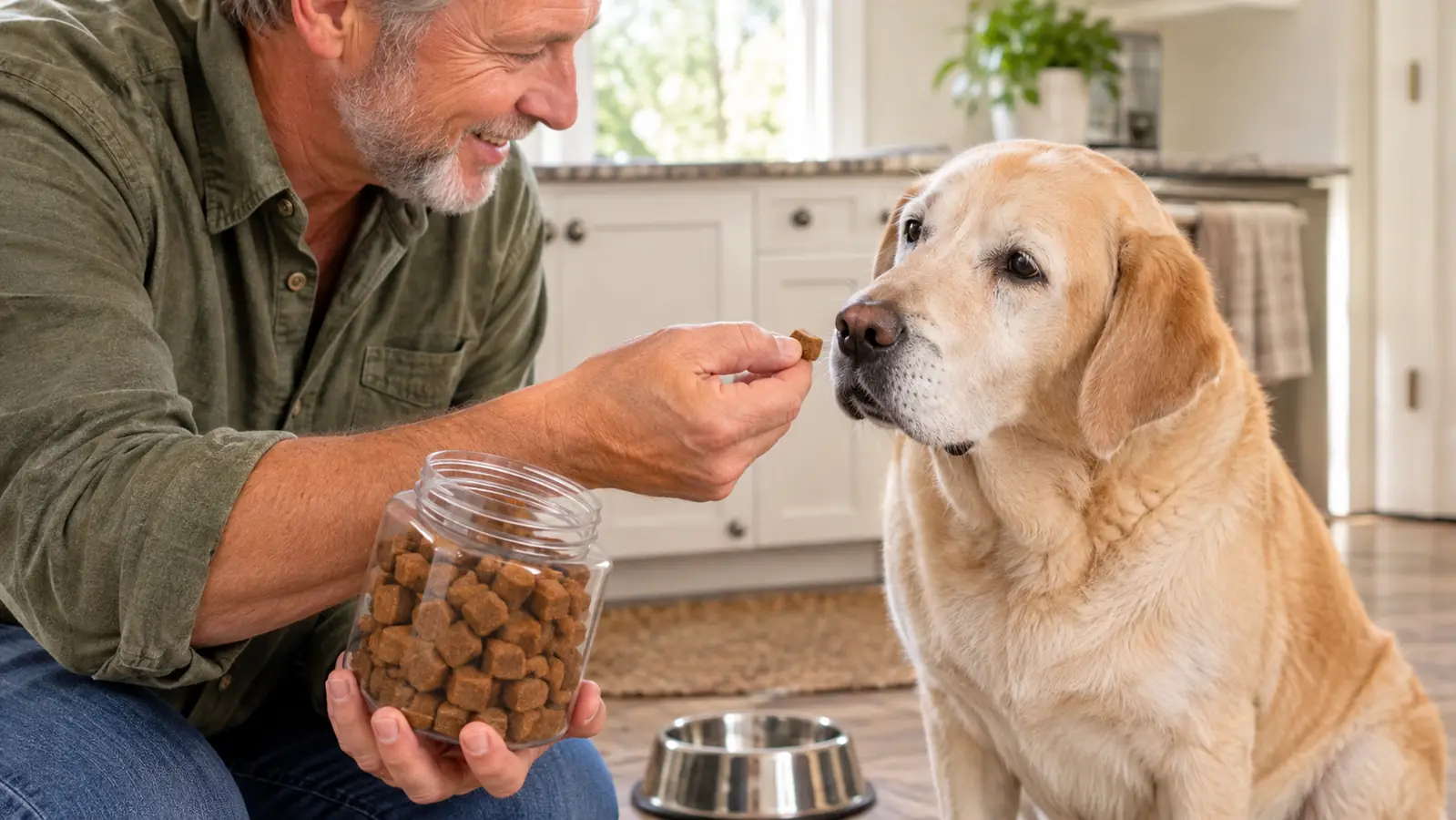
What's In the Chew (and Why I Care)
The label lists 1000 mg of glucosamine HCl and 1000 mg of MSM per chew, plus green-lipped mussel. Glucosamine is the ingredient every joint supplement leans on, and MSM is the one I look for because it is meant to support the connective tissue around the joint. The green-lipped mussel is the part that is a little less common, and it brings its own kind of support for normal joint comfort.
The whole formula is 10 active ingredients, the tub is certified by the National Animal Supplement Council, and the brand says it is trusted by over 15,000 veterinarians. That matters to me more than the picture on the front. I read labels and compare milligrams, and VetriScience GlycoFlex is honest about what is in it.
It is also veterinarian-formulated, which I know sounds like a label claim, but for a supplement I am giving an 11-year-old dog, I want the people who made it to have talked to actual vets. Dr. Patel had heard of the brand, which is more than I can say for some of the bottles at the big-box pet store.
The other thing I like is that the tub is straightforward. Sixty chews, a clear label, no vague language hiding the real amounts. I have bought supplements where the label felt like it was trying to impress me instead of inform me. This one just tells you what is in it, and that is the kind of label I trust.
What Changed in About Three Months
The honest answer is that nothing changed in the first week. Juno was still slow getting up, still stopped at the top of the porch steps, and I almost switched back to the pricier tablet. I am glad I did not, but I want to be straight with you: if you try this, the first week may tell you nothing. Give it the full tub before you decide.
By week three, I noticed she was getting up on the first try most mornings. Not every morning, but most. The rock-forward-and-try-again thing happened less, and she stopped hesitating at the top of the porch steps, which was the small thing I had been watching for. It was not dramatic, it was just easier. I kept a kind of mental log, the way I keep track of her appetite and energy, and by the second month the good mornings were coming more often than the bad ones.
The car is still a project. She needs the step stool, and on bad days she still needs a hand under her rear end. Nothing about this chew made her young again, and I would not want you to think otherwise. But the everyday stiffness, the part that made me wince when I watched her stand up, that got quieter. The porch steps are the small test I watch closest. For a while she would stand at the top and look down, then take each step like it was a decision. By the second month she was going down them in one motion, the way she used to. Coming back up is still slower, and I do not push her, but the hesitation at the top is mostly gone.
Winter is the real test around here. Cold mornings are harder for her, and I have to remind myself that a supplement is not a weather machine. But this stretch, she has been moving better than she did last winter, and I give a lot of the credit to keeping her lean and moving, with the chew doing its part.
The Tradeoffs I Found
First, the cost. This is the cheaper alternative I tried, and I will not pretend it is cheap. Joint supplements for a 74-pound dog add up, and you have to decide whether it is worth it for your dog. For us it was, but I understand why someone would balk at another recurring cost on top of food and vet visits.
Second, the soft chew is a treat to Juno, which is good and bad. Good because she takes it without a fight, no crumbling, no hiding it in her bowl. Bad because she would eat the whole tub if I let her, so it lives on the top shelf, and I have to be careful every time I open that cabinet.
Third, it takes weeks to know if it is working. If you are looking for something that helps in two days, this is not it. I nearly quit in week one, and I think a lot of people will do the same. You have to give it a fair month, and that is a real cost of your time and money. Fourth, it did not fix the car problem or the worst days. I still lift her rear end, I still use the stool, and on damp mornings she is still stiff. This is support, not a repair. I think that distinction matters more than any number on the label.
One more thing worth knowing: the 60-count tub is easy to travel with, which matters to us because we drive to see family. I toss the tub in the back of the SUV next to the step stool and her food, and I do not have to think about it. A pill bottle would work too, but the soft chews do not crumble in the bag the way some tablets do.

How It Compared to What We'd Tried Before
Juno has had joint supplements on and off for about two years, one at a time, always with Dr. Patel's okay. We started with Cosequin, which she took crumbled over her food for about eight months. It was fine, and I still keep a tub as a fallback, but she never took it eagerly. Then came a mussel-based soft chew from Zesty Paws, which we used for about four months. Juno loved the taste and treated it like a cookie, but I did not see the same change in her mornings that I saw with GlycoFlex. Taste matters, but it is not the same as seeing your dog get up easier.
The step up from Cosequin is Dasuquin, the one Dr. Patel mentioned by name, and it is the priciest of the five we have tried. For about three months I had Juno on VetriScience GlycoFlex instead, as the cheaper alternative. I honestly could not tell the difference in how she moved between the two. That is the highest compliment I can give a cheaper option.
Through all of it, she has had Nordic Naturals fish oil on her food every morning for about a year. That is not a joint chew, it is for her skin, coat, and overall comfort. I mention it because a lot of the improvement we see is probably the combination working together, not any single tub on its own.
I want to be fair about the comparison. The pricier tablet and this chew share a lot of the same thinking, glucosamine and MSM and green-lipped mussel, so maybe it is no surprise they came out about even in my informal test. What surprised me was that the cheaper option held its own. I went in expecting to miss the tablet, and I did not.
What I Liked
- Soft, chicken-flavored chew that Juno takes like a treat, no crumbling or hiding it in her bowl
- 1000 mg of glucosamine HCl and 1000 mg of MSM per chew, plus green-lipped mussel
- NASC certified and veterinarian-formulated, which matters to me for a daily supplement
- Noticeable change in her morning stiffness by week three
- Cheaper than the pricier tablet I was using before, with results I could not tell apart
Where It Falls Short
- Took about three weeks before I saw anything, and I nearly quit in week one
- Did not help with the car or the worst damp-morning stiffness
- She loves it so much I have to keep the tub out of reach
- It is support, not a repair, and it needs realistic expectations
I could not tell the difference in how Juno moved between the pricier tablet and this chew. That is the highest compliment I can give a cheaper option.
Who This Is For
If you have an older dog whose mornings are getting stiff, and your vet has said a joint supplement is reasonable to try, this is a fair place to start. It is especially good if your dog is picky about pills, because the soft chew makes it easy, and especially if the pricier options make you wince, because we got the same result for less.
It is also for people who can be patient. You have to give it about a month and watch honestly, the way you would watch any change in an older dog. If you can do that, you will know whether it is working, and you will not have wasted the money wondering. And if you are the kind of person who reads labels and compares milligrams, you will find this one easy to read.
Who Should Skip It
If your dog is already on a joint supplement that is working, do not switch just because this one costs less. I switched because I wanted to save money, and it worked out for us, but I would not have risked a change if Juno had been struggling. If it is not broken, there is no reason to fix it.
If your dog has a diagnosed condition that needs a vet's plan, a supplement is not a substitute for that plan. Ask your vet first and follow their advice over anything you read here. And if you expect a chew to fix a bad hip or make a stiff dog run like a puppy, this is not that. Nothing is.
Still on the Fence? This Is the Budget Chew I'd Pick
Three months in, I could not tell the difference between GlycoFlex and the pricier tablet, so if the pricier tablet ever stops fitting the budget, this is the one I would reach for. Check today's price on Amazon, and talk to your vet before you start.
Amazon Check Today's Price on Amazon →